
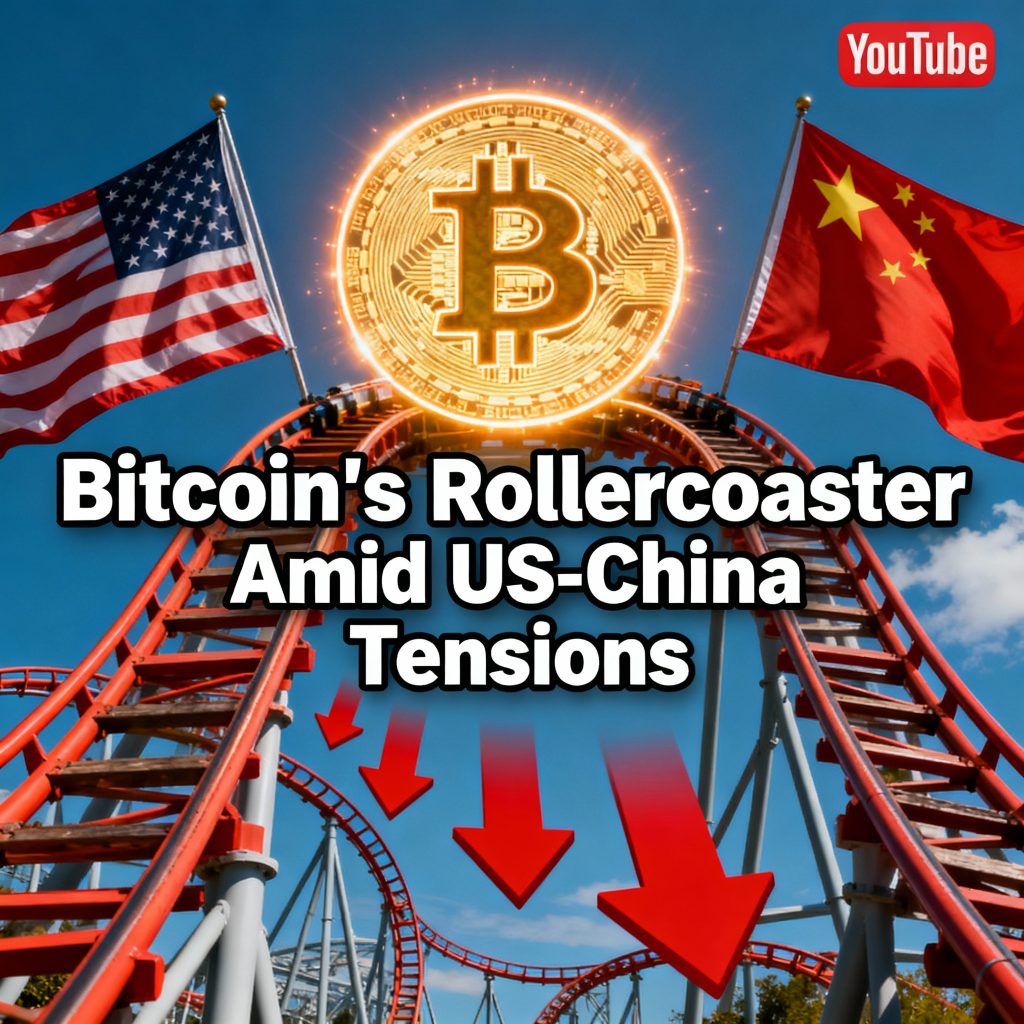
Honestly, October 2025 has been an absolutely wild ride for anyone involved in crypto. I’ve been in this space for years—long enough to remember when a 20% drop was just another Tuesday—but watching $370 billion in market capitalization vanish in a matter of hours still sent a chill down my spine. The whole event felt less like a market correction and more like a car skidding off a cliff. And the driver? An escalating trade war between the US and China that has turned digital assets like Bitcoin into a geopolitical football.
What’s so fascinating (and, frankly, a bit terrifying) is how this whole episode has forced a reckoning with Bitcoin’s identity. For years, we’ve been sold this idea of Bitcoin as a “safe haven asset,” our “digital gold” that would protect us from the chaos of traditional finance. Yet, when the geopolitical instability really hit the fan, Bitcoin didn’t act like a safe haven. It acted like a high-risk tech stock, plunging right alongside the Nasdaq. We’re witnessing a full-blown identity crisis, and I’m not entirely sure Bitcoin—or the rest of us investors—knows which way is up.
Anatomy of a Flash Crash
So, what exactly happened on October 10?
Picture this: it’s a Friday afternoon, and Bitcoin is cruising comfortably around $122,500. All seems well in the cryptocurrency ecosystem. Then, around 4 PM CST, the floor completely fell out from under the market.In what felt like the blink of an eye, Bitcoin experienced a flash crash, plummeting to an intraday low below $104,000. That’s a 15% decline in almost no time. Altcoins got hit even harder. Ethereum, the second-biggest player, got absolutely demolished, dropping nearly 20% from $4,400 to around $3,500. Others like Solana and XRP saw similar double-digit losses. It was a sea of red, and my phone started blowing up with panicked messages from friends.Of course, this wasn’t random market volatility. The timing was impeccable. The crash began just moments after President Donald Trump announced his plan to slap a new 100% tariff escalation on Chinese goods. This wasn’t just a threat; it was a bombshell that sent a shockwave of fear through the global financial markets.But the real accelerant was the massive amount of leverage in the system. The crash triggered a catastrophic chain of crypto liquidations. Over $19 billion in leveraged positions were wiped out in 24 hours—a grim, new record for the industry. It was a brutal lesson in how leverage unwinding during a liquidity crisis can turn a bad situation into a historic disaster, especially over a weekend when trading volumes are naturally thinner.
When Geopolitics Slams into the Blockchain
Here’s the part that I keep wrestling with. Theoretically, blockchain technology is borderless. The Bitcoin network doesn’t care about economic sanctions or container ships. And yet, the correlation between US-China relations and Bitcoin price movements has become impossible to ignore.This latest round of trade tensions began heating up after China imposed restrictions on American units tied to a South Korean shipbuilder, a direct retaliation against US measures targeting its own shipping industry. Trump’s countermove—the massive tariff threats—was paired with talk of export controls on everything from laptops to jet engines. The situation got even spicier when China hinted it might tighten its grip on rare earth exports, materials that are absolutely critical for modern technology. It created a vicious cycle of threat and counter-threat that killed all risk appetite in the market.What’s different this time around? In past trade disputes, like back in 2018, many of us (myself included) saw Bitcoin as a potential escape hatch, a hedge against a devaluing yuan. But not anymore. Bitcoin has achieved a degree of mainstream adoption, and with that comes a price: it’s now tethered to the broader market sentiment. When Wall Street sneezes, the digital asset landscape now catches a cold.
An Identity Crisis: Digital Gold or High-Tech Dice?
This brings us to the philosophical heart of the matter. Is Bitcoin a legitimate financial asset or just a speculative instrument? The “digital gold” connotation took a serious beating in October. As Bitcoin was in a freefall, what was actual gold doing? It was surging, behaving exactly as a safe haven is supposed to. That divergence tells a story that many in the crypto space don’t want to hear. When true fear grips the markets, big money still runs to what it knows: gold, U.S. Treasuries, and the dollar. For now, they see digital currencies as part of the risk asset bucket, not the safety bucket. The dream of Bitcoin decoupling from traditional markets remains just that—a dream. But hold on, it’s not that simple. Digging into the on-chain data from firms like Glassnode reveals a fascinating counter-narrative. The amount of Bitcoin held in “illiquid” wallet addresses—meaning wallets that rarely sell—has been steadily climbing. This suggests a growing army of long-term believers who are engaging in accumulation, using this turbulence to buy more at a discount. This points to one of Bitcoin’s rare attributes: strong institutional and long-term holder buying during downturns. So we have a split personality: short-term traders see it as a risky bet, while long-term holders see it as the future. Which one is right? Honestly, I’m not sure anyone knows for certain.

The Leverage Bomb That Wrecked the Market
Let’s dive a bit deeper into that leverage bomb, because it’s crucial to understanding what happened. The market was saturated with traders using futures contracts and other derivatives to make super-sized bets on Bitcoin’s price going up. This works great in a bull market, but in a bear market, it’s a recipe for disaster.When Trump’s tariff tweet hit, the sudden price plunge triggered a flood of margin calls across all the major crypto exchanges. Traders were forced to either add more collateral to their accounts instantly or have their positions automatically sold off by the exchange. In a fast-moving market, this forced selling pushes the price down even further, which triggers more liquidations. It’s a death spiral. To make matters worse, Binance, the world’s largest exchange, experienced “technical issues” right in the middle of the chaos, adding to the panic. It’s a reminder that even the biggest players in the blockchain industry aren’t immune to strain during extreme events.And then there’s the truly juicy part of the story—one of those unique attributes you only see in crypto. The on-chain analytics firm Arkham flagged a whale who opened a massive $234 million short position just 30 minutes before the tariff news broke. This trader timed the crash perfectly, walking away with a fortune and leaving everyone else to wonder if they had inside information. It adds a layer of distrust and manipulation fears to an already chaotic situation.
Following the Money: A Tale of Two Bitcoin Markets
While retail traders were getting wiped out, the world of institutional adoption was telling a completely different story. It was a classic case of antonyms in action: panic selling vs. calm buying. On October 22, well after the initial crash, BlackRock’s iShares Bitcoin ETF (IBIT) recorded a massive inflow of $210.9 million. Think about that. While the market was still shaking, one of the world’s biggest asset managers saw its clients pouring hundreds of millions of dollars into Bitcoin. This wasn’t panic; this was strategy. It suggests that institutional money saw the dip as a discount, a buying opportunity for a long-term play.This created a stark divergence between the spot market and the derivatives market. Spot buyers, many of them institutions using ETFs, were in accumulation mode. Meanwhile, the futures market was a bloodbath of liquidation and fear. It’s a fascinating example of price discovery happening in real-time, with two completely different sets of investors coming to opposite conclusions about Bitcoin’s value. The long-term believers are playing chess while the short-term traders are playing poker, and the game is far from over.
Where Do We Go From Here?
So, what’s next? All eyes are on the upcoming trade negotiations. Trump has set a November 1 deadline, threatening to raise tariffs to a staggering 155% if a deal isn’t reached with Xi Jinping. If he follows through, the October slump could look like a pleasant memory. Such a move would almost certainly trigger another, perhaps deeper, flight from risk assets. On the other hand, any sign of de-escalation could bring stability back to the market and send prices soaring. Traders are also keeping a close eye on the Federal Reserve and upcoming inflation data. Hotter inflation could, ironically, bolster Bitcoin’s case as an inflation hedge. The background noise of regulatory uncertainty also continues to play a role, as it always does in crypto. What does this mean for you, the investor? First, be extremely careful with leverage. It’s like playing with fire in a dynamite factory right now. Second, understand what you own. If you believe in Bitcoin’s long-term potential as a digital currency, then dips like this might be opportunities. If you see it as a speculative trade, then the volatility is a signal to be cautious. Your strategy should depend entirely on your time horizon and risk appetite.
The Ride Isn’t Over
Bitcoin’s October rollercoaster was more than just a wild swing in price; it was a stress test of its entire narrative. The crash revealed its vulnerabilities to geopolitical instability and its deep connections to the traditional financial world. The safe haven story is, for now, on hold. Yet, amid the chaos, the quiet accumulation by institutional players suggests the long-term thesis remains intact for some of the biggest players on Wall Street. Bitcoin is simultaneously a failed safe haven and a prized long-term asset, a speculative gamble and a technological revolution.It’s messy, it’s contradictory, and it’s confusing. And honestly? It’s what makes this space so incredibly compelling. The ride is far from over, and I’d suggest buckling up. The only thing we know for sure is that more turbulence is ahead.